Machine Productivity Features
Machine Utilisation
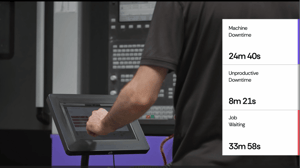
FourJaw provides standardised machine utilisation data, enabling you to identify inefficiencies and optimise existing resources.
Production Timeline
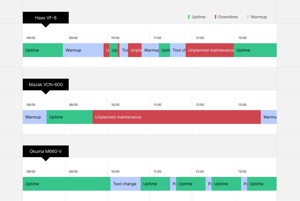
We make manufacturing Production monitoring easy. Get a true view of machine downtime, see overall production performance, and use the insight to anticipate issues ahead of the next shift.
Downtime Reporting
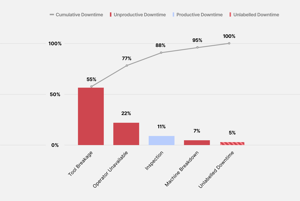
Understand the top causes of machine downtime and their effect on costs and performance. Take corrective action to target downtime where it matters most using Pareto analysis.
Production Count
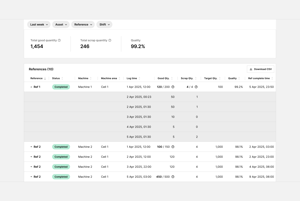
Log production counts in real-time with automatic quality tracking and part counting on FourJaw.
Whether you're counting finished items, boxes, or monitoring defect rates, Part Count gives you real-time visibility of the shop floor.
OEE Availability
Track OEE availability in real time and react to downtimes immediately to keep your OEE on track.
.png?width=300&name=OEE%20Availkability%20(Medium).png)
FourJaw's Features
Everything you need to streamline and optimise processes to grow your business.
Streamline processes to reduce costs, boost speed, and enhance efficiency.

Simplify planning and communication for a more efficient factory floor.

Cut energy waste, streamline processes, and shrink your carbon footprint.
FAQ
Machine monitoring improves productivity by giving manufacturers real-time visibility into machine utilisation, downtime, production performance, and operational inefficiencies. By continuously tracking how equipment is performing, manufacturers can identify bottlenecks, reduce idle time, minimise downtime, and increase output from existing machines and production lines.
Machine monitoring systems provide the data needed to make faster, more informed decisions about production processes, staffing, scheduling, and capacity planning. This helps manufacturers improve overall equipment effectiveness (OEE), increase machine utilisation, and uncover hidden production capacity without investing in additional equipment.
Many manufacturers also use machine monitoring as part of their wider continuous improvement programmes, including Lean manufacturing, Kaizen, and operational excellence initiatives. The data generated helps teams identify improvement opportunities, prioritise actions, measure results, and drive ongoing productivity gains across the factory.
Yes, machine monitoring is a core part of a production monitoring system. Both help manufacturers collect, track, and analyse real-time production data to improve productivity, efficiency, and factory performance.
Machine monitoring focuses on capturing data directly from manufacturing equipment, including machine utilisation, downtime, uptime, cycle times, and production status. Production monitoring systems use this data, alongside job, operator, and production information, to provide a broader view of manufacturing performance across machines, shifts, production lines, and sites.
By monitoring production in real time, manufacturers can identify bottlenecks, reduce downtime, improve OEE, optimise resource allocation, and make data-driven decisions that increase output and improve operational efficiency. This visibility helps teams understand where production losses occur and which improvements will have the greatest impact on productivity and profitability.
Productivity is one of the most important measures of manufacturing performance because it directly impacts output, profitability, competitiveness, and long-term business growth. Manufacturers with higher productivity can produce more goods using the same resources, helping them reduce costs, improve margins, and respond more effectively to customer demand.
Manufacturing productivity measures how efficiently a factory converts inputs such as labour, machinery, energy, materials, and production time into finished products. By improving productivity, manufacturers can increase production capacity, reduce waste, improve machine utilisation, minimise downtime, and generate more value from existing resources.
Improving manufacturing productivity is a key objective for operations managers, production teams, and continuous improvement specialists, as even small productivity gains can have a significant impact on factory performance and profitability. Many manufacturers use machine monitoring and production analytics to identify inefficiencies, uncover hidden capacity, and drive continuous improvement initiatives that deliver measurable productivity improvements.
Manufacturers use a range of continuous improvement methodologies and productivity tools to reduce waste, improve efficiency, increase output, and optimise factory performance. These approaches help businesses identify inefficiencies, improve production processes, increase machine utilisation, and drive sustainable productivity improvements.
Some of the most widely used manufacturing productivity methodologies include:
Yes. FourJaw is designed to work with both modern and legacy manufacturing equipment, making it suitable for factories with machines of any age, make, or model.
Unlike many manufacturing software platforms that rely on complex integrations or newer equipment, FourJaw can connect to older machines and provide real-time visibility into machine utilisation, downtime, uptime, production performance, and energy consumption. This allows manufacturers to collect valuable production data from equipment that may not have built-in connectivity or digital monitoring capabilities.
By turning legacy equipment into connected, data-generating assets, FourJaw helps manufacturers improve productivity, identify bottlenecks, reduce downtime, and increase machine utilisation without the need for costly machine replacements or major capital investment.
Many manufacturers use FourJaw as a practical first step towards Industry 4.0 and smart manufacturing, gaining real-time factory visibility from both new and existing equipment across the shop floor.
FourJaw captures downtime data automatically using a combination of MachineLink hardware and operator input. When a machine stops running, FourJaw detects the downtime event in real time and prompts the operator to select the reason for the stoppage using a tablet mounted at the machine.
Operators can quickly choose from a predefined list of downtime reasons, such as machine breakdowns, material shortages, setup activities, maintenance, quality issues, or operator-related delays. This process takes only a few seconds and is designed to fit seamlessly into normal production workflows.
By combining automated machine monitoring with operator context, FourJaw provides manufacturers with accurate, real-time downtime data and a clear understanding of why production losses occur. This enables production teams to identify recurring downtime causes, perform root cause analysis, reduce unplanned downtime, improve machine utilisation, and increase overall equipment effectiveness (OEE).
The result is more accurate production data, better operational decision-making, and a stronger foundation for continuous improvement initiatives.
Yes, we have a number of manufacturing success stories that provide real-life examples of how manufacturers have benefited from our machine monitoring platform. Here are some examples that focus on productivity improvement:
Ready to
Learn More?
See how FourJaw's production monitoring platform can help you turn machine data into real productivity gains.