

Discover how data-driven manufacturing improves productivity, workforce engagement and continuous improvement. Learn the best practices behind high-performing factories.

Empowering Today's Manufacturing Workforce with Data
Table of contents
loading...
Why People Are the Next Productivity Frontier in Manufacturing
For decades, manufacturers have focused on improving machine efficiency, reducing downtime and optimising production processes. While these remain critical priorities, many manufacturers are discovering that the next productivity frontier lies elsewhere: empowering the people who operate, manage and improve those processes every day.
In an environment shaped by rising costs, skills shortages and increasing competitive pressure, manufacturers need more than technology alone. They need a culture where data supports better decision-making, greater autonomy and stronger engagement across the workforce.
The most successful manufacturers are moving beyond traditional management approaches and creating data-driven environments built on visibility, trust and continuous improvement.
This article explores the role of culture and technology adoption to drive productivity in the manufacturing landscape.
From Gut Feel to Data-Driven Decision-Making
Manufacturing has always relied on experience and intuition. However, as operations become more complex, decisions based on assumptions or anecdotal evidence are increasingly difficult to justify.
Modern manufacturers need objective, real-time production data to identify improvement opportunities, prioritise investments and resolve operational challenges.
When manufacturers gain visibility into machine utilisation, downtime and production performance, they can focus improvement efforts on the issues causing the greatest impact rather than the most visible frustrations.
The results can be significant:
-
Small and medium-sized manufacturers achieve median productivity gains of 30%
-
Larger organisations report median output increases of 16%.
-
Real-time data provides clear justification for capital investments and improvement projects.
-
Operational decisions become evidence-based rather than reactive.
By replacing opinion with fact, manufacturers can allocate resources more effectively and drive measurable improvements across the factory.
Why Workforce Engagement Matters
A data-driven culture delivers benefits far beyond machine performance.
Research consistently shows that engaged employees are more productive, safer and more committed to continuous improvement. According to Gallup, highly engaged workforces are:
- 14–18% more productive
- 23% more profitable
- 32% less likely to experience quality defects
- 63% less likely to experience safety incidents
The connection between data and engagement is often overlooked. However, when employees have access to meaningful operational information, they gain greater clarity, ownership and confidence in their role.
The Three Foundations of Workforce Engagement
A transparent manufacturing environment supports three critical psychological needs:
01. Autonomy
When operators can see performance data and understand the causes of downtime, they can take ownership of improvement rather than waiting for management intervention.
02. Certainty
Real-time visibility removes uncertainty. Instead of guessing how production is performing, teams can focus on solving problems with confidence.
03. Fairness
Objective data creates a shared understanding of performance. Feedback and improvement discussions become fact-based rather than subjective, helping build trust across the organisation.
Visibility Creates Better Manufacturing Performance
Faster Problem Solving
Real-time alerts allow teams to respond to issues as they occur rather than discovering them hours or days later. Problems can be resolved before they become significant production losses.
Greater Operator Autonomy
Access to live production data enables operators to make informed decisions independently. Rather than waiting for supervisors, teams can identify issues, prioritise actions and maintain momentum throughout the shift.
Improved Cross-Functional Collaboration
Traditional manufacturing environments often operate in silos. Visibility helps break down these barriers by creating a shared understanding of challenges and performance across departments.
When everyone can see the impact of downtime and bottlenecks, improvement becomes a collective responsibility rather than an individual one.
Turning Opinion into Fact
One of the greatest advantages of manufacturing analytics is the ability to replace assumptions with evidence.
Operational leaders are frequently required to make decisions about:
-
Equipment investments
-
Maintenance priorities
-
Staffing requirements
-
Production scheduling
-
Continuous improvement initiatives
Without reliable data, these decisions often depend on experience, instinct or incomplete information.
Real-time production data allows leaders to identify the true causes of lost productivity, build stronger business cases and focus resources where they will deliver the greatest return.
Whether the challenge is a recurring tooling issue, a material shortage or an underperforming asset, data provides the clarity needed to act with confidence.
Download the Whitepaper

Technology Must Work for People
Technology only creates value when people use it.
For manufacturing analytics to succeed, systems must be simple, intuitive and designed around the realities of the shop floor.
Successful implementations share several characteristics:
-
Minimal disruption to existing workflows
-
Simple deployment without complex integrations
-
Easy-to-understand dashboards and interfaces
-
Clear benefits for operators and managers alike
The goal is not to create more administration. It is to remove friction and make work easier.
Giving Operators a Voice
The people closest to production often have the best understanding of what is happening.
When operators can quickly record downtime reasons and production issues, manufacturers gain valuable context that machine data alone cannot provide.
This combination of automated production monitoring and operator insight creates a far more accurate picture of factory performance while ensuring frontline teams remain central to improvement efforts.
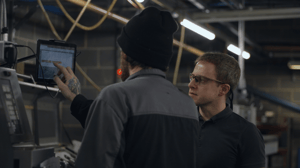
Building a Data-Driven Culture
Technology implementation is rarely the biggest challenge. Cultural adoption is.
Many employees initially worry that monitoring systems are designed to track individuals rather than improve operations. Successful manufacturers address this concern through transparency and communication.
Focus on Support, Not Surveillance
Leaders must clearly explain that production monitoring systems are designed to understand machine performance, identify bottlenecks and improve processes—not monitor people.
When employees understand the purpose of the data and see tangible improvements resulting from it, trust grows naturally.
Start Small and Prove Value
A phased implementation approach often delivers the strongest results.
Beginning with a pilot area allows manufacturers to demonstrate quick wins, solve visible problems and build momentum before expanding across the wider operation.
As teams experience the benefits first hand, adoption becomes significantly easier.
Check out our manufacturing success stories here to learn how other manufacturers have created a data-driven culture across their manufacturing operations.
Sustaining Continuous Improvement
Long-term success requires more than visibility alone.
The most effective manufacturers embed data into their daily operating rhythm through structured review processes and continuous learning.
This often includes:
-
Daily operational reviews
-
Weekly improvement meetings
-
Monthly strategic performance analysis
-
Operator-led discussions around downtime and productivity
By making data part of routine decision-making, organisations transform continuous improvement from an occasional initiative into an everyday habit.
Upskilling the Workforce
Digital technologies should enhance human capability rather than replace it.
By removing low-value administrative tasks and providing greater operational insight, manufacturers enable employees to focus on problem-solving, innovation and technical development.
At the same time, exposure to production analytics, automation and digital tools helps develop the skills required for the future of manufacturing.
The Future of Manufacturing Is Human-Centred
The shift towards data-driven manufacturing is not fundamentally a technology transformation. It is a cultural one.
Manufacturers that create environments built on visibility, autonomy and trust achieve more than higher productivity. They develop more engaged workforces, stronger continuous-improvement cultures, and greater operational resilience.
The next generation of manufacturing performance will not come solely from smarter machines or AI. It will come from empowering the people who use them.
Download the Complete Guide
This article provides an overview of the principles behind a data-driven manufacturing workforce. For a deeper exploration of workforce engagement, operational visibility, continuous improvement and manufacturing analytics, download our full whitepaper:
Fundamental Data Best Practices in Manufacturing: Empowering Today's Manufacturing Workforce.