Skip to content
Manager looking at screens-1

Getting the most out of your
FourJaw demo

Help your team prepare for a FourJaw demo with guidance on what to expect, who should attend, key questions to consider and useful resources to review.
Everything you need to know

A FourJaw demo is designed to help you understand how real-time production monitoring could support your factory, your people and your improvement goals.

It is not just a tour of the software.

The best demos are focused on your world: your machines, your production challenges, your current data gaps and what success would look like for your business.

This page will help you prepare, so the session is useful, relevant and worth everyone’s time.

Read on to find out more. 

FourJaw staff member on demo call

Who should attend?

The most valuable demos usually include people who understand both the day-to-day reality of production and the wider business goals.

Where possible, we strongly recommend inviting:

Operations or Production Leaders

People responsible for output, capacity, efficiency, planning or shop-floor performance.

They can help identify where better visibility would have the biggest operational impact.

Continuous/Process Improvement or Lean Teams

People responsible for reducing waste, improving processes, increasing machine utilisation or tackling recurring downtime.

They can help connect the demo to improvement projects already underway.

Engineering or Maintenance Teams

People who understand machine behaviour, stoppages, reliability and technical constraints.

They can help assess how machine data could support better decisions and faster problem-solving.

Senior Leaders & Finance People responsible for growth, investment, productivity or strategic decision-making.

They can help evaluate the commercial value of better production data, from increasing capacity to supporting future investment decisions.
IT or Systems Teams FourJaw is designed to be quick and simple to deploy, but IT colleagues may want to understand connectivity, data security, access and integration options.

They do not always need to attend the full demo, but it can be useful to include them early if there are specific technical questions.
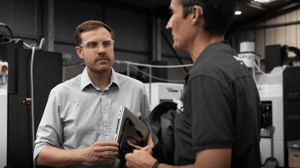
Production manager and shop floor supervisor talking

What to think about before the demo

You do not need to prepare anything formal.

However, it helps to have a quick discussion internally before the call about where better production visibility could make the biggest difference.

Here are some useful questions to consider.

Where do you currently lack visibility?

For example:

  • Which machines, cells or production areas are hardest to understand?

  • Where are you relying on manual checks, spreadsheets or operator notes?

  • Where do you often have to make decisions without reliable data?

  • Are there differences between shifts, sites or teams that are difficult to compare?

What production challenges are you trying to solve?

Think about the problems that come up repeatedly.

For example:

  • Machine downtime

  • Low utilisation

  • Missed output targets

  • Unplanned stoppages

  • Changeover delays

  • Labour pressure

  • Resource planning

  • Planning challenges

  • Difficulty proving capacity

  • Lack of confidence in manual production data

  • Limited visibility across different machines or sites

What would better data help you do?

FourJaw is most valuable when data insight turns into action.

Before the demo, think about what you would want to do with real-time production insight.

  • Increase output without adding more machines
  • Understand true available capacity
  • Reduce avoidable downtime
  • Improve shift performance
  • Support continuous improvement projects
  • Make better investment decisions
  • Give operators and team leaders clearer information
  • Track progress against production targets
  • Input and track Continuous Improvement targets
  • Build more confidence in customer delivery plans to support OTD
Which machines or processes matter most?

You may want to think about:

  • Your highest-value machines
  • Bottleneck machines
  • Machines with frequent downtime
  • Older machines with limited digital connectivity
  • Lines where output varies between shifts
  • Areas where manual reporting is currently time-consuming or unreliable

FourJaw can monitor a wide range of machine types, including legacy equipment, so it is useful to know where you would want to start.

What does success look like?

A good demo should help you understand what value could look like in your business.

Before the call, consider what success might mean for you and the wider business.

For example:

  • A measurable increase in utilisation
  • Reduced downtime
  • Better visibility for managers and operators
  • Less time spent collecting and cleaning data
  • More accurate production meetings
  • Stronger evidence for improvement projects
  • A clearer case for investment
  • Improved confidence in capacity planning
  • Reduced COGS

You do not need exact targets at this stage. A broad idea of what you would like to improve is enough to stimulate the conversation.

Get inspired.
Read real customer stories.

Questions to bring to the demo

Without putting words in your mouth, here are some questions you may want to think about asking us during the demo.

  • How FourJaw connects to machines?

  • What hardware is required?

  • How long installation typically takes?

  • Whether FourJaw works with older machines?

  • How operators interact with the system?

  • What dashboards and reports are available?

  • How are downtime reasons captured?

  • How can data be viewed by shift, machine, area or site?

  • What support is provided during rollout?

  • How manufacturers typically use FourJaw after go-live?

  • What results similar manufacturers have achieved?

Useful resources before your demo

Before the call, you may find it useful to explore a few resources or share them with your colleagues.

Ready for your demo?

The best FourJaw demos are open, practical and focused on your production reality.

Bring your questions. Bring your colleagues. Bring your challenges. Bring the areas where you know better visibility could make a difference.

We will show you how FourJaw works, but more importantly, we will help you explore where real-time production data could create value for your business.

We look forward to seeing you on the call. 

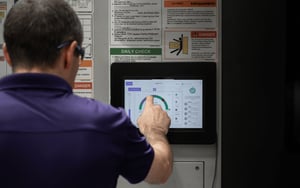
machine operator logs downtime